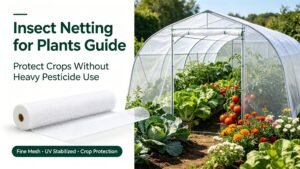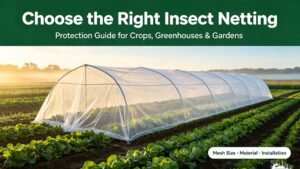
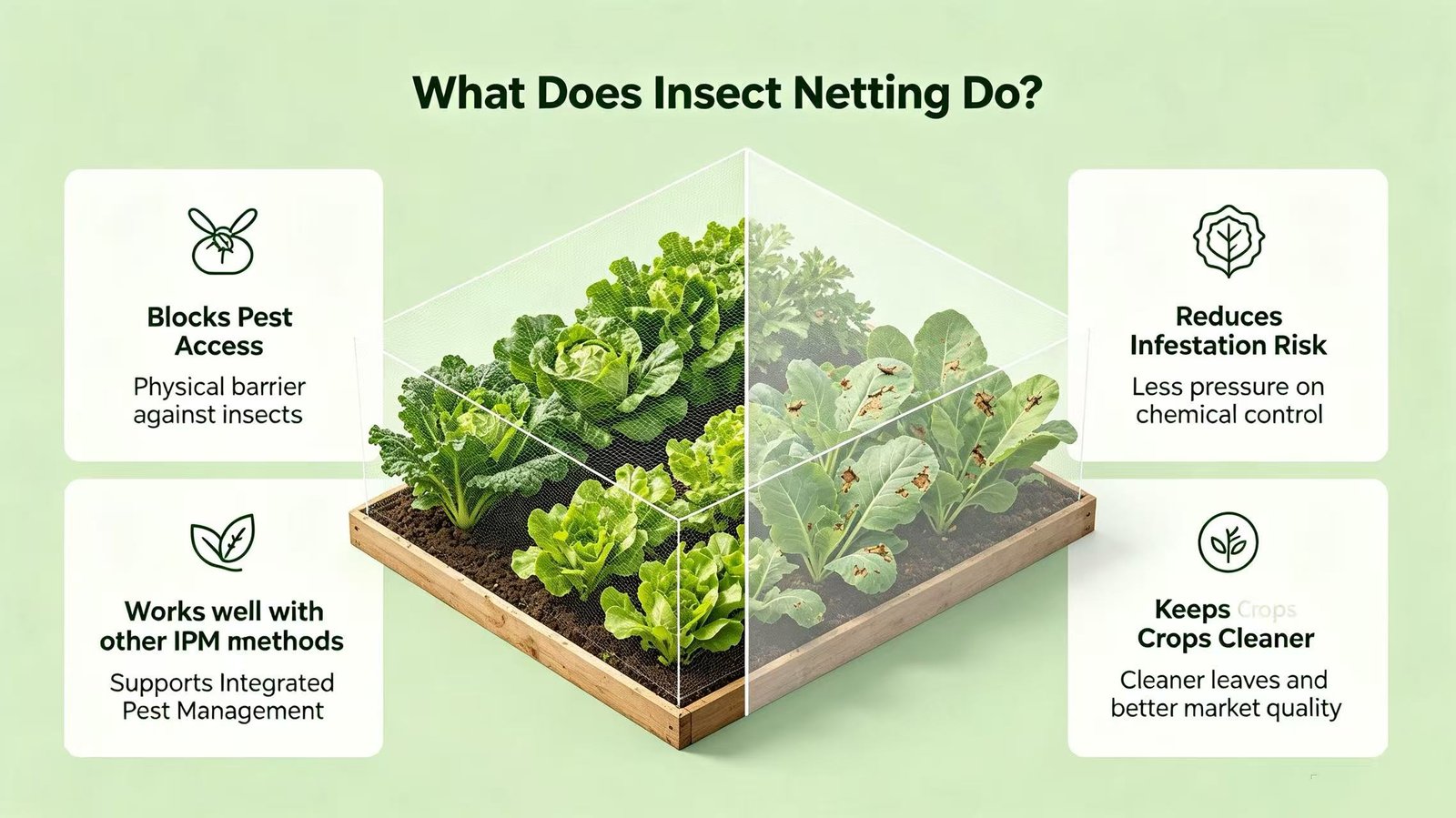
Fine insect-proof netting, with openings suited to the target pest, helps protect crops by forming a physical barrier. When choosing insect netting for plants, check which insects you need to exclude, when they reach the crop and whether flowers need access to pollinators.
The covering also needs a complete boundary. Select the mesh for the pest, then plan how you will close the edges, reach the crop and keep suitable growing conditions beneath it.
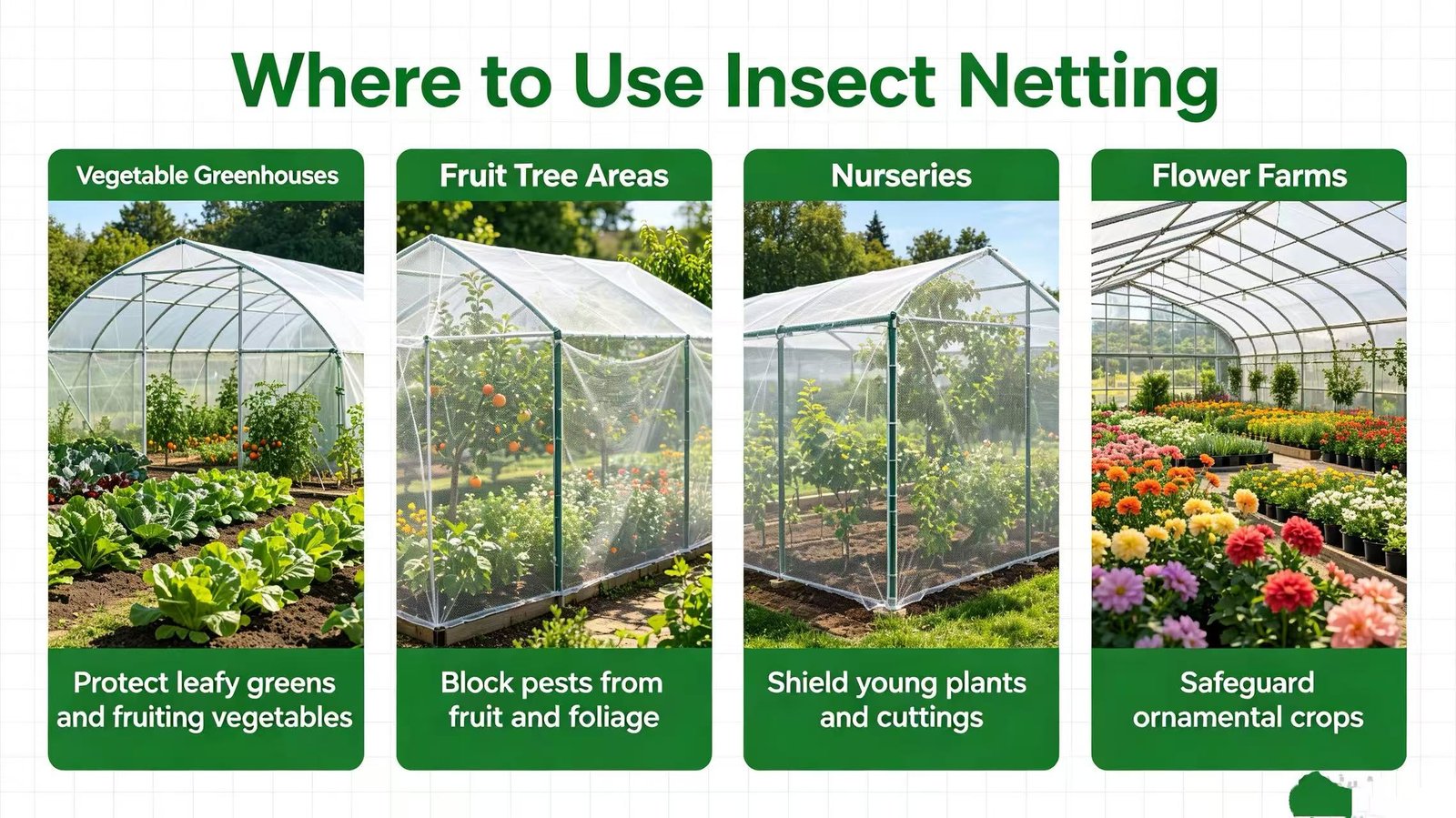
Which Netting Protects Crops from Insects?
Choose a product intended for insect exclusion, supported by information about the pests it can exclude. Smaller insects generally require finer openings. A description such as garden netting gives you little information about the actual barrier. The Royal Horticultural Society explains how insect-proof mesh protects vulnerable crops and why the mesh needs to match the insects involved. RHS insect-proof mesh guide
Start by separating the jobs that different coverings perform.
| Covering | Main purpose | What to check for crop protection |
|---|---|---|
| Fine insect-exclusion netting | Restrict entry by specified insects | Opening dimensions, pest suitability and edge closure |
| Bird netting | Restrict access by birds | A bird-protection label alone gives no insect-exclusion specification |
| Shade netting | Reduce incoming sunlight | Obtain separate evidence if insect exclusion is also required |
| Spunbonded row cover | Modify growing conditions and exclude some pests | Crop suitability, heat retention and access for pollination |
Spunbonded row covers and fine insect mesh can both serve crop-protection plans. However, they affect temperature differently. The New England Vegetable Management Guide describes fine-mesh insect netting as providing much less heat retention than spunbonded covers, with little or no frost protection. Select the covering for the growing conditions as well as the pest. New England Vegetable Management Guide
Choose Insect Netting for Plants by Pest
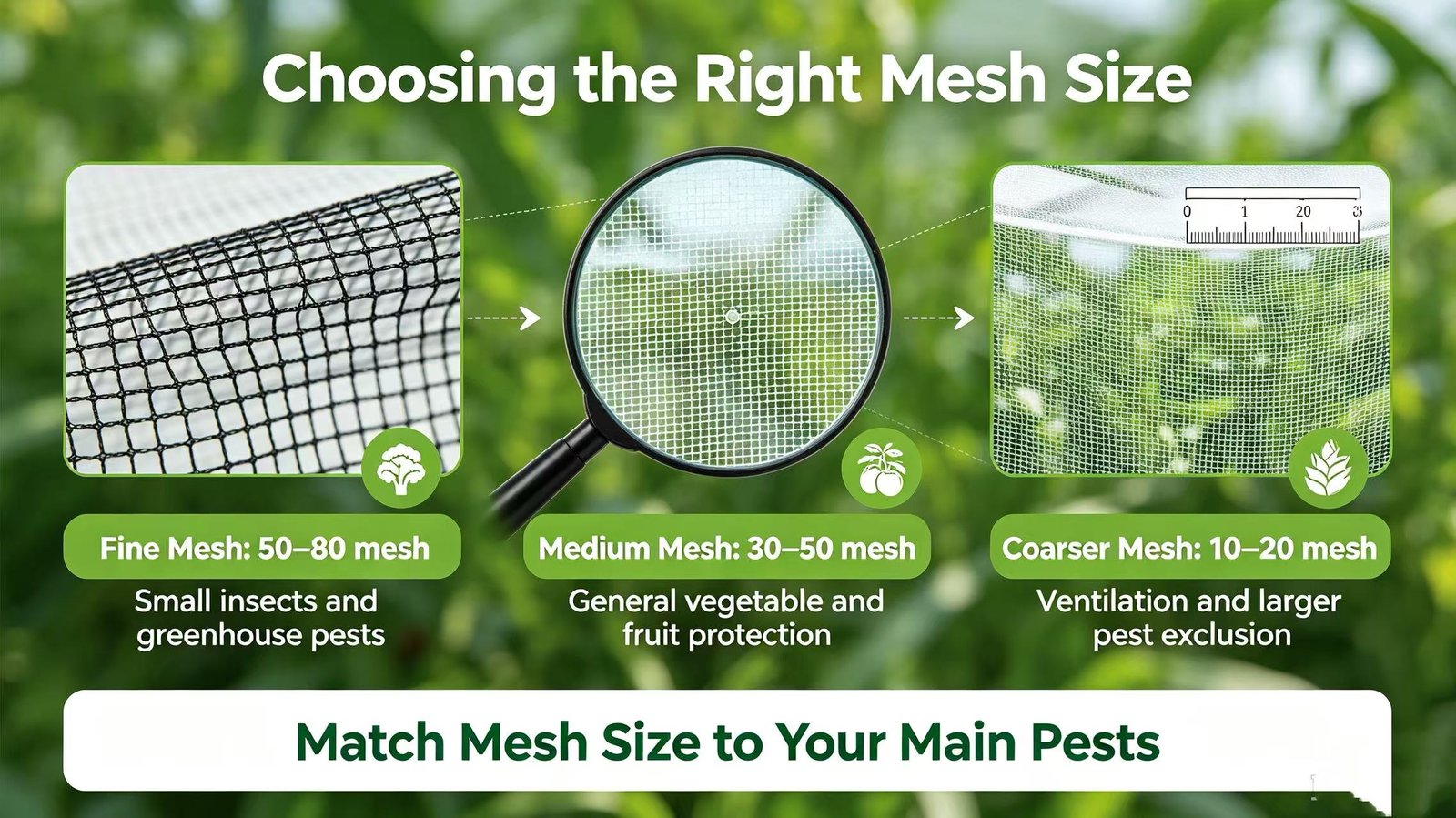
First, identify the insect or obtain help identifying it. A covering selected to stop a larger moth may have openings that allow a smaller pest through. If several insects threaten the crop, give your supplier the full list.
Ask for the actual opening dimensions and evidence relevant to your target pest. Also state whether the material will cover plants directly, sit over hoops or attach to a larger enclosure. Utah State University Extension stresses matching the selected mesh grade to the insect and considering the timing of exclusion. Utah State University Extension
For a detailed discussion of mesh specifications, ventilation and quotation comparisons, use Xingke’s existing selection guide. Insect netting buying guide
Install the Barrier Before Pest Entry
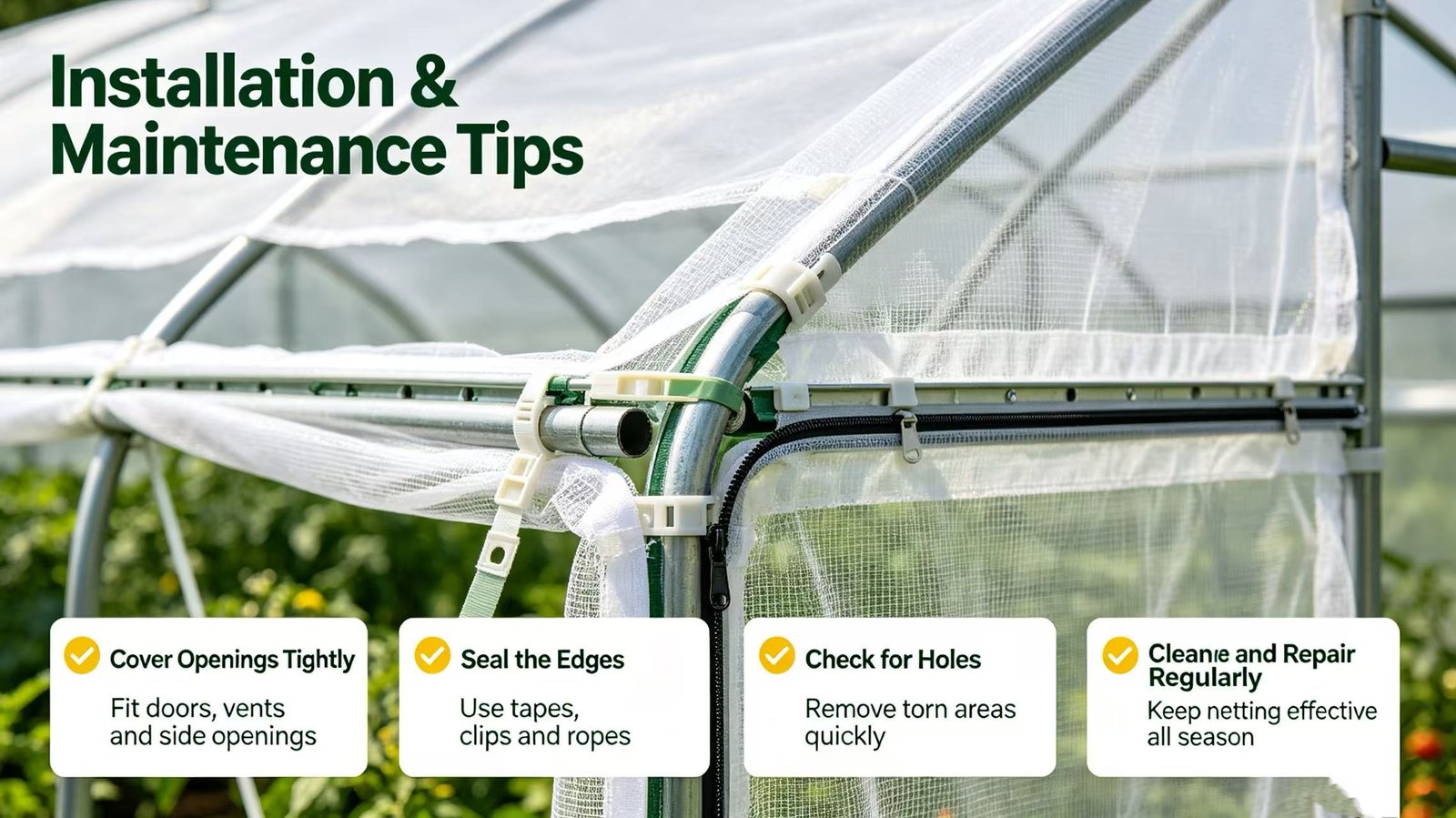
Install the covering while the crop is ready for protection and before the target insect has access. Inspect transplants and the growing area first. Pests already present on plants, or emerging from the soil beneath a cover, can remain inside the enclosure. Include crop history and local pest activity in the timing decision. University of Maryland Extension
For example, consider a new bed of young leafy plants. Before covering it, check the transplants and remove visible pest problems. Then fit the selected material over the planned supports and secure the perimeter. This is a planning example, so the installation date and pest checks still need to suit the site.
Decide how workers will inspect and harvest the crop. A liftable edge may be practical for a small bed, while a larger enclosure may need a dedicated entrance. After each visit, check that the opening closes properly.
Plan Insect Netting for Plants That Need Pollination
A barrier can exclude pollinating insects as well as pests. Therefore, decide how the crop will receive pollination before choosing to keep it covered through flowering.
Conventional squash and cucumber cultivars that depend on insects need pollinator access at bloom. Some parthenocarpic cultivars can produce fruit without pollination and offer another management option. University of Maryland Extension explains these differences in its pollination guidance, updated in July 2026. Check the cultivar and production plan before setting the cover schedule. University of Maryland Extension
Opening a cover for flowering also changes pest access. Record that period in the crop plan and continue inspecting plants. For commercial enclosed production, discuss any managed-pollination arrangement with a crop adviser.
Leave Space for Growth and Manage the Covered Crop
Allow space for the crop to grow beneath the chosen material. A support frame can help keep the covering away from foliage and make crop access easier. Check the manufacturer’s installation instructions before stretching the net, since tension can alter the openings. Insects may also lay eggs through mesh where it touches leaves. RHS insect-proof mesh guide
During warm weather, check conditions around the plants. Even a permeable covering changes the growing environment, so inspect crop growth and soil moisture as part of the routine. Leave enough access to reach irrigation fittings and repair damaged sections.
Use the same inspection route each time. Start at the entrance, follow the edges and joins, then check the plants in several places. Keep notes on where insects or damage appear so you can look for a recurring entry point.
Check the Cause When Damage Appears
If you find feeding damage beneath insect netting, inspect both the crop and the enclosure. Identify the insect if possible, then check the openings and recent crop-management work.
| Observation | What to investigate |
|---|---|
| Damage near an access point | Recent opening, incomplete closure or a loose edge |
| Insects on recently introduced plants | Transplants and other material brought into the covered area |
| Repeated damage beneath intact mesh | Pest identity, opening suitability and pests already inside |
| Damage where leaves touch the cover | Crop clearance and the pest’s egg-laying behaviour |
These observations help direct an inspection. Confirm the cause before changing the mesh specification or covering the next crop.
Discuss the Crop-Protection Task Before Ordering
Xingke’s insect-net product page covers crop coverings, greenhouse openings and protected cultivation. Use the intended application to guide the specification discussion. Xingke insect-net range
Send the crop, target insect, location and expected period of use. Include a drawing or photographs showing the support frame, access points and the dimensions to be covered. Also describe any pollination requirement and how the crop will be inspected.
Ask the supplier to confirm the selected material, opening dimensions, finished sizes and installation requirements. Finally, include the quantity, delivery destination and preferred timing. Sample availability and supply terms need confirmation in the quotation. Contact the Xingke team
Frequently Asked Questions
Can ordinary garden netting protect against small insects?
Check the product’s opening dimensions and intended exclusion task. Ask for evidence for the target insect before using it as a crop barrier.
Can insect-proof netting stay over every crop until harvest?
The cover schedule depends on growth, pollination and conditions beneath the material. Review those needs as the crop develops, and plan access for inspection and harvest.
Does insect netting for plants also provide frost protection?
Fine insect mesh generally provides little or no frost protection. Where cold protection is required, select a covering with suitable crop and temperature guidance.